
How Is Cartilage Restoration Done for Knee Injuries?
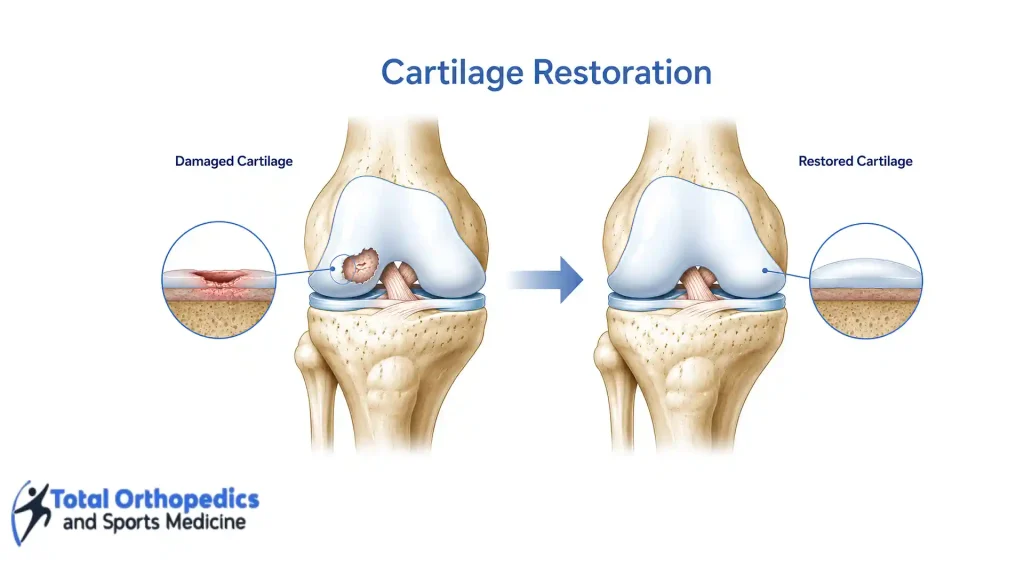
Doctors perform cartilage restoration by replacing damaged cartilage with healthy cartilage tissue or stimulating new cartilage growth. However, your orthopedic surgeon selects the most appropriate technique based on the size, location, and depth of the injury. The goal is to relieve pain, improve mobility, and help protect your knee from further joint damage.
At Total Orthopedics & Sports Medicine, our orthopedic specialist, Dr. Michael Shindle, carefully evaluates the cause of your cartilage injury before recommending treatment. He reviews your symptoms, imaging, activity level, and long-term goals to determine whether cartilage restoration is the right option. His priority is to preserve your natural knee, restore smooth joint movement, and help you return to the activities you enjoy. Call 855-321-6784 to book your appointment.
How Does Cartilage Restoration Help Treat Knee Injuries?
Cartilage restoration helps repair damaged articular cartilage to reduce pain, improve joint movement, and support cartilage function. As healthy cartilage is restored, your knee can move more smoothly with less discomfort. This treatment also helps protect the joint from further damage and may delay the need for more extensive or open surgery.
Unlike treatments that mainly manage symptoms, knee cartilage restoration focuses on rebuilding the damaged area whenever possible. Restoring a smoother joint surface helps your knee distribute weight more evenly with each step. This reduces excessive stress on the surrounding cartilage and underlying bone. Another important benefit is preserving the overall health of your knee over time. By addressing a localized cartilage injury early, cartilage restoration helps maintain the joint’s normal structure. This creates a healthier environment for long-term knee function.
As your knee heals, cartilage restoration can provide several additional benefits, including:
- Improve shock absorption within the knee
- Preserve the underlying bone beneath the cartilage
- Maintain the knee’s natural cushioning effect
- Reduce abnormal bone-on-bone contact
- Support healthy cartilage healing
- Improve tolerance for repetitive daily activities
- Increase comfort during low-impact exercise
- Preserve more natural knee biomechanics
- Improve force transfer across the knee joint
- Promote healthier joint mechanics over time
What Is Knee Cartilage and How Does It Work?
Knee cartilage is a strong, smooth tissue that cushions your knee joint and allows the bones to glide smoothly during movement. It also helps absorb the forces placed on your knee with every step. As a result, the joint can move efficiently while minimizing stress on the underlying bone.
In addition, your knee contains two main types of cartilage, and each has a different role. Articular cartilage covers the ends of the bones within the joint and provides a smooth surface that allows the bones to move efficiently. In contrast, the meniscus is a C-shaped structure that occupies the space between the bones. It helps improve joint stability and distributes forces across the knee during movement. Because these tissues perform different functions, injuries to each tissue require different treatment approaches.
How Does Cartilage Get Damaged?
Cartilage gets damaged when excessive force or repeated stress injures the smooth tissue inside the knee. This commonly occurs during sports injuries, falls, or sudden twisting movements. Over time, repeated joint loading and age-related wear can also weaken the cartilage, making it more vulnerable to damage.
Here are some of the sports most commonly associated with knee cartilage injuries:
- Soccer: Sudden pivoting, tackling, and kicking place repeated stress on the knee.
- Basketball: Frequent jumping, landing, and quick direction changes increase cartilage loading.
- Football: Direct collisions and twisting movements can injure the knee joint.
- Rugby: High-impact tackles and rapid changes in direction increase injury risk.
- Wrestling: Forceful twisting and rotational movements place significant stress on the knee.
- Hockey: Skating, sharp turns, and player contact increase stress on the joint.
- Skiing and Snowboarding: Falls and twisting injuries commonly damage knee cartilage.
- Gymnastics: Repeated landings from jumps create high forces across the knee.
- Volleyball: Jumping and landing place repetitive impact on the joint.
A scoping review published in the Orthopedic Journal of Sports Medicine reported that knee cartilage injuries are particularly common among athletes participating in pivoting and high-impact sports, such as soccer and basketball. The authors noted that these injuries may result from acute trauma or repetitive microtrauma during sports that place high loads on the knee joint.
Another review published in the Osteoarthritis and Cartilage explained that excessive or abnormal mechanical loading can gradually damage articular cartilage by disrupting normal cartilage homeostasis and accelerating tissue degeneration. Over time, these changes increase the risk of cartilage degeneration and symptomatic knee injuries.
What Types of Cartilage Injuries Affect the Knee?
The types of cartilage injuries that affect the knee include cartilage fissures, articular cartilage defects (partial-thickness defects or full-thickness defects), and osteochondral injuries. These joint injuries vary in size, depth, and severity. Therefore, doctors evaluate each injury carefully before recommending treatment.
Here is how each type of cartilage injury affects your knee:
Cartilage Fissures
Cartilage fissures are small cracks that develop on the surface of the cartilage. They often occur after repetitive stress or a minor injury. At first, the damage may involve only a limited area. However, continued stress on the knee can gradually cause the fissure to enlarge over time. Early treatment may help prevent further cartilage breakdown.
Partial-Thickness Cartilage Defects
A partial-thickness defect is one of the smaller cartilage defects and affects only part of the cartilage layer. The cartilage remains attached to the underlying bone. However, the damaged surface becomes less smooth than normal. This can interfere with normal joint movement during daily activities. Without appropriate treatment, the defect may gradually worsen.
Full-Thickness Cartilage Defects
A full-thickness defect extends through the entire cartilage layer. As a result, the bone beneath the cartilage gets exposed. This large cartilage defect increases stress on the affected area during weight-bearing activities. Many patients notice more persistent symptoms as the defect enlarges. Moreover, these injuries often require specialized treatment to restore joint function.
Osteochondral Injuries
An osteochondral injury affects both the cartilage and the underlying bone. These injuries commonly occur after a significant sports injury or direct trauma. In some cases, a small piece of cartilage and bone may become loose inside the joint. Because two tissues are affected, these injuries are often more complex than isolated cartilage defects.
What Are the Symptoms of Knee Cartilage Damage?
Knee cartilage damage commonly causes pain, swelling, stiffness, and a reduced range of motion. Some people also notice clicking, catching, or locking sensations during movement. Symptoms may gradually worsen as the damaged area enlarges or is subjected to repeated stress.
Additionally, you may notice the following cartilage damage symptoms depending on the location and severity of the injury:
- Knee weakness during weight-bearing activities
- A feeling that the knee may give way
- Difficulty squatting or kneeling
- Discomfort when climbing or descending stairs
- Pain after prolonged sitting, followed by movement
- Difficulty returning to sports or higher-impact activities
- Reduced ability to tolerate prolonged walking
- Tenderness over the affected area of the knee
- A grinding sensation during certain knee movements
- Difficulty performing activities that require repeated knee bending
At Total Orthopedics & Sports Medicine, many patients tell us they initially notice symptoms only during sports or longer periods of activity. Over time, the discomfort begins to interfere with routine tasks such as climbing stairs, squatting, or getting up after sitting for a while. Although the symptoms may seem mild initially, they should not be ignored. Without timely evaluation, the cartilage defect may enlarge and limit later treatment options. If you continue to experience knee pain or swelling, schedule an evaluation with Dr. Michael Shindle before the cartilage injury progresses further.
How Do Orthopedic Surgeons Confirm Cartilage Damage?
Our knee specialist, Dr. Michael Shindle, carefully evaluates your symptoms, examines your knee, and reviews your imaging studies to identify the location and severity of cartilage damage. MRI is often the preferred because it provides detailed images of the cartilage and surrounding soft tissues. When additional information is needed, he may recommend arthroscopy to directly evaluate the cartilage and determine the most appropriate treatment.
In addition, Dr. Michael Shindle carefully assesses how your knee performs during the physical examination. He evaluates your knee both at rest and during movement, including bending, straightening, squatting, and weight-bearing activities, because some cartilage injuries become more noticeable under load. He also compares your injured knee with the healthy one to identify differences in movement, tenderness, swelling, and overall knee function. Together, these findings help distinguish cartilage damage from other conditions that can cause similar symptoms.
Who Is a Good Candidate for Cartilage Repair?
Doctors usually recommend cartilage repair for younger patients with a single injury, stable knees, and little or no advanced arthritis when non-surgical knee treatment fails. Besides that, patients younger than 50 achieve more favorable outcomes, with some procedures offering the best results in patients under 40 with isolated defects. However, the final recommendation depends on the overall condition of the knee rather than age alone.
Here are some other factors doctors evaluate before recommending cartilage repair:
- Good overall physical health
- Healthy knee alignment
- No active infection in or around the knee
- A healthy body weight that supports recovery
- Symptoms that have not improved with non-surgical treatment
- Healthy subchondral bone beneath the cartilage defect
- Realistic expectations about recovery and rehabilitation
- No uncontrolled medical conditions that may affect healing
- A commitment to attending regular follow-up appointments
- No history of smoking or a commitment to smoking cessation before surgery
How Do Surgeons Choose the Right Procedure?
Our sports medicine surgeon, Dr. Michael Shindle, chooses the right cartilage restoration procedure (chondroplasty, microfracture, OATS, or ACI) based on the size, location, and depth of the cartilage defect. He also evaluates the condition of the surrounding bone, knee alignment, and your activity level. Depending on your evaluation, Dr. Michael Shindle may recommend one of the following procedures:
Chondroplasty
Chondroplasty smooths damaged cartilage to reduce friction inside the knee joint. Rather than restoring lost cartilage, the procedure removes loose or damaged cartilage fragments that interfere with normal joint movement. Surgeons usually perform it through an arthroscopic procedure using specialized instruments. It is most often recommended for small areas of unstable cartilage or early cartilage damage in an injured joint. In selected patients, chondroplasty can improve symptoms, restore mobility, and delay the need for more advanced cartilage restoration procedures.
Microfracture
The microfracture technique is a minimally invasive procedure used to treat small, full-thickness cartilage defects. During the procedure, the surgeon creates tiny holes in the bone beneath the damaged cartilage using a specialized surgical instrument. This stimulates bone marrow stem cells to enter the defect and form new repair tissue.
The goal is to encourage the growth of new cartilage cells through the body’s natural healing process. In addition, microfracture is generally recommended for smaller cartilage injuries in younger, active patients. It can reduce symptoms and improve knee function when the surrounding joint remains healthy. However, the repair tissue differs from normal cartilage, so careful patient selection is important.
Autologous Chondrocyte Implantation (ACI)
Autologous chondrocyte implantation (ACI) uses your own healthy cartilage cells to repair larger cartilage defects. Initially, surgeons use arthroscopy to collect a small sample of healthy cartilage from an area of the knee that is not exposed to significant weight-bearing force. These cells are then grown in a specialized laboratory to increase their number before being implanted into the damaged area during a second surgery. The goal is to regenerate cartilage that more closely resembles normal hyaline cartilage than traditional repair tissue.
A newer variation of this technique, called Matrix-Induced Autologous Chondrocyte Implantation (MACI), follows a similar two-step cartilage repair process but places the cultured cartilage cells onto a specialized collagen membrane before implantation. Both ACI and MACI knee cartilage repair are generally recommended for younger, active patients with larger cartilage defects and healthy knee joints.
Osteochondral Autograft Transplantation (OATS)
Osteochondral autograft transplantation replaces damaged cartilage using healthy cartilage and bone taken from another part of your own knee. Small cylindrical plugs are transferred into the cartilage defect to restore the knee joint surface. Because the graft is taken from your own body, there is no risk of tissue rejection. This procedure is most commonly recommended for smaller to medium-sized defects. It restores both the cartilage and the supporting bone in a single operation.
Osteochondral Allograft Transplantation
Osteochondral allograft transplantation replaces damaged cartilage and underlying bone with donor tissue. It is generally reserved for larger cartilage defects that cannot be treated effectively with an autograft. The donor graft is carefully matched to fit the damaged area of the knee. This procedure restores articular cartilage and helps repair damaged cartilage without removing healthy cartilage from another part of your knee. Moreover, it is often considered when extensive cartilage loss involves both cartilage and bone, and aims to support long-term cartilage regeneration.
Can Cartilage Repair Be Combined With Other Surgeries?
Yes, surgeons often combine cartilage repair with other knee procedures when multiple structures require treatment. Treating associated problems during the same surgery can improve affected joint mechanics and support long-term outcomes. However, your orthopedic surgeon recommends this approach only when it is appropriate for your condition.
Depending on your diagnosis, cartilage repair may be combined with one or more of the following common procedures:
- ACL Reconstruction: Restores knee stability when an ACL tear contributes to abnormal joint loading, which can occur alongside meniscal or ligament tears.
- Meniscus Repair: Preserves the knee’s natural shock absorber and helps reduce stress on the repaired cartilage.
- High Tibial Osteotomy: Corrects abnormal knee alignment to distribute weight more evenly across the joint.
- Loose Body Removal: Removes loose cartilage or bone fragments that interfere with normal joint movement.
- Ligament Reconstruction: Restores stability when additional ligament injuries affect normal knee function.
A systematic review of 40 studies involving 1,783 knees reports that combining cartilage restoration with realignment surgery (osteotomy) did not compromise outcomes. In fact, correcting associated problems during the same procedure was associated with lower failure rates and improved functional outcomes, particularly in patients with knee malalignment or meniscal deficiency.
What Are the Risks and Complications of Cartilage Repair?
Cartilage repair carries potential risks such as infection, stiffness, blood clots, persistent pain, and incomplete healing. Although most patients recover without major complications, every surgical procedure involves some degree of risk. However, your individual risk depends on the type of procedure, your overall health, and the condition of your knee.
Here are some other potential complications of cartilage repair:
- Graft failure or poor graft integration
- Cartilage delamination (separation of the repaired cartilage)
- Overgrowth of repair tissue (graft hypertrophy)
- Continued swelling after rehabilitation
- Reduced knee function despite treatment
- Persistent catching or locking sensations
- Damage to the surrounding cartilage
- Limited return to high-impact sports
- Need for additional cartilage procedures
- Revision surgery if the repair does not achieve the expected outcome
Although no surgery is completely risk-free, Dr. Michael Shindle carefully plans every stage of cartilage repair to help minimize potential complications whenever possible. Before recommending cartilage surgery, he carefully evaluates your cartilage defect, knee stability, alignment, overall health, and activity goals to ensure you are an appropriate candidate. During the procedure, he uses meticulous surgical techniques designed to protect the surrounding normal, healthy articular cartilage.
After surgery, he provides a structured recovery plan and closely monitors your recovery to identify any concerns early. This personalized approach helps support healing and reduces the risk of avoidable complications. If knee cartilage damage is affecting your daily activities or sports, schedule an evaluation with Dr. Michael Shindle to receive a personalized treatment plan.
How Long Does It Take to Rebuild Cartilage in the Knee?
According to our experience, rebuilding cartilage in the knee typically takes 3 to 6 months, although the exact recovery timeline varies depending on the cartilage restoration procedure performed. Most patients use crutches for up to six weeks to protect the repaired area during the early stages of healing. Some procedures also require continuous passive motion therapy to support early cartilage recovery and maintain joint movement.
While early healing begins within the first few months, full recovery and cartilage maturation often take six months to a year, depending on the procedure and your individual healing response. In fact, a review of 46 studies found that patients showed meaningful improvements by 3 to 6 months after articular cartilage restoration, with continued gains through 12 months.
When Can You Return to Sports After Surgery?
Most patients can return to sports approximately 3 to 18 months after knee cartilage repair surgery, although the exact timeline depends on the procedure performed and their recovery progress. A systematic review of 179 studies found that recovery time varies by cartilage restoration procedure. The average return-to-sport ranged from 4.9 months after osteochondral autograft transfer (OAT) to 11.6 months after autologous chondrocyte implantation (ACI).
Here are the key milestones our orthopedic surgeon evaluates before allowing you to resume sports:
- Restore full knee range of motion without pain or significant stiffness.
- Regain normal strength in the injured leg compared with the opposite side.
- Walk, jog, and change direction comfortably without swelling afterward.
- Perform sport-specific drills under the guidance of the doctor.
- Progress from low-impact to high-impact activities instead of returning all at once.
- Receive clearance from your orthopedic surgeon before participating in competitive sports.
- Stop and report any pain, swelling, or instability that develops during your return to activity.
What Can Affect Your Cartilage Restoration Results?
The outcome of cartilage restoration depends on the condition of your knee, the procedure your surgeon performs, and your body’s healing response. Your rehabilitation, activity level, and commitment to your recovery plan also play an important role in supporting long-term healing. As a result, healing timelines and outcomes vary from one patient to another.
Other factors that may affect your cartilage restoration results include:
- Location of the cartilage injury within the knee
- Quality of the surrounding cartilage
- Condition of the underlying subchondral bone
- Healthy knee alignment before surgery
- Presence of meniscal or ligament injuries
- Smoking or nicotine use during recovery
- Maintaining a healthy body weight
- Control of chronic medical conditions, such as diabetes
- Following weight-bearing restrictions during early recovery
How Can You Protect Your Knee After Recovery?
You can protect your knee after recovery by strengthening the surrounding muscles, maintaining a healthy body weight, and gradually returning to activities. These habits support normal joint mechanics and reduce stress on the repaired cartilage. Regular follow-up also helps monitor your long-term progress.
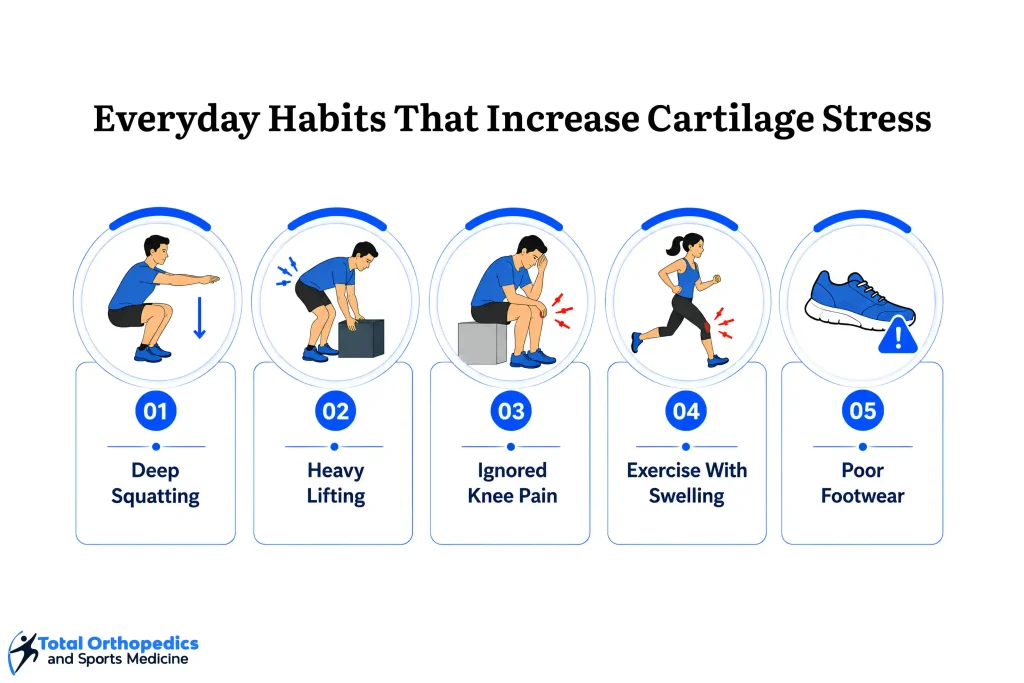
Even after you have fully recovered, your everyday habits continue to affect the long-term health of your knee. Therefore, warming up before exercise, using proper movement techniques, and avoiding repetitive stress on the joint are essential to protect the repaired cartilage. However, if pain, swelling, or other symptoms return despite these precautions, seek an orthopedic evaluation promptly.
How Long Can Cartilage Restoration Last?
Cartilage restoration can last 10 years or longer, although its lifespan depends on the procedure performed, the condition of your knee, and your recovery. Many patients continue to experience meaningful improvements in pain and knee function for years after treatment.
According to a review in The American Journal of Sports Medicine, matrix-induced autologous chondrocyte implantation (MACI) showed sustained improvements in pain and knee function for 10 years or longer. The review also reported low graft failure rates and a relatively low progression to knee replacement in appropriately selected patients.
Visit Dr. Michael Shindle for Advanced Cartilage Restoration for Knee Injuries!
You have tried to modify your activities and wait for your knee to improve, yet the pain, swelling, or catching keeps returning. Meanwhile, everyday movements become more difficult, and the damaged cartilage may continue to deteriorate. Without treatment, a small cartilage defect can gradually worsen.
At Total Orthopedics & Sports Medicine, Dr. Michael Shindle focuses on preserving your natural knee by treating cartilage injuries before they lead to more extensive joint damage. Every treatment recommendation is based on your cartilage defect, knee mechanics, and long-term recovery goals. We also provide convenient online resources for referrals, bill payments, patient forms, and appointment requests. For comprehensive evaluation and follow-up care in one convenient location, call 855-321-6784 or visit our clinic.
FAQs
How Painful Is Knee Cartilage Surgery?
Most patients experience moderate pain after knee cartilage surgery, particularly during the first few days of recovery. This pain gradually improves as healing progresses. However, following your postoperative instructions and recovery plan helps reduce discomfort and supports healing.
How Much Does Knee Cartilage Restoration Cost?
The average cost of knee cartilage restoration ranges from approximately $5,000 to $70,000, depending on the procedure and your insurance coverage. Simpler procedures, such as microfracture, usually cost less than advanced treatments. Your orthopedic surgeon can provide a personalized cost estimate after evaluating your knee.
Can Articular Cartilage Grow Back Naturally?
No, articular cartilage has a very limited capacity to regenerate naturally because it lacks a direct blood supply. As a result, damaged cartilage rarely heals on its own after a significant injury. However, cartilage restoration procedures can help repair or replace damaged cartilage in appropriately selected patients.
Can Knee Cartilage Damage Be Treated Without Surgery?
Yes, knee cartilage damage can be treated without surgery, particularly when the defect is small or the symptoms are mild. Doctors may recommend medications such as NSAIDs for pain control and to reduce inflammation. They may also recommend joint injections, which can lubricate the joint and reduce localized inflammation.
Can You Walk After Knee Cartilage Surgery?
Yes, most patients can walk after knee cartilage surgery, although they usually need crutches for several weeks to protect the repaired cartilage. The amount of weight you can place on your knee depends on the procedure performed and your surgeon’s recommendations.
Is Cartilage Restoration Better Than Knee Replacement?
No, cartilage restoration is not always better than knee replacement because each procedure treats a different type of knee problem. Cartilage restoration is designed for localized cartilage defects in patients with healthy knees. In contrast, knee replacement treats advanced arthritis involving the entire joint.


