

What Is Spondylolisthesis?
Spondylolisthesis happens when one vertebra slips forward over another in the spinal column, usually in the lumbar spine. This condition can cause lower back pain, muscle tightness, and even radiating pain down the legs. In many cases, gentle movements can help manage these symptoms, while spinal surgery may be considered for more severe cases.
If you’re struggling with back pain or suspect spondylolisthesis, ignoring the issue can lead to worsening symptoms, including nerve injury and lumbar instability. At Total Orthopedics & Sports Medicine, our specialists are committed to effectively treating spondylolisthesis through personalized treatment plans designed to restore your mobility. Contact us at 855-321-6784 to schedule your consultation and begin your journey toward lasting relief.

What Causes Spondylolisthesis in the Spine?
Spondylolisthesis is most commonly caused by stress fractures, degenerative changes from aging, or congenital conditions present from birth. Other significant factors, such as trauma, pathologic conditions, and spinal instability, can also contribute to this condition. Understanding the exact cause is essential in developing the most effective treatment plan and preventing further spinal damage.
As you age, the facet joints and discs in your spine naturally wear down, increasing the risk of lumbar spondylolisthesis. Additionally, a stress fracture—often seen in athletes or individuals who engage in repetitive movements. Congenital conditions like dysplastic spondylolisthesis may also contribute to this misalignment from birth, while traumatic injuries can cause sudden slippage.
In some cases, pathologic spondylolisthesis, resulting from spinal tumors or infections, can further aggravate the issue. Therefore, understanding these underlying causes is crucial to developing the right treatment plan. According to the National Center for Biotechnology Information (NCBI), approximately 6% of the general population has a spondylolysis (pars defect), with about one-third of these individuals developing some degree of spondylolisthesis.
What Are the Key Symptoms of Spondylolisthesis?
The primary symptoms of spondylolisthesis include lower back pain, muscle tightness, and radiating pain down the legs. You may also experience numbness, weakness, and difficulty standing for long periods. In severe cases, bladder control issues or leg weakness can occur, especially if the spinal nerve roots are compressed.
As the vertebra slips out of alignment, it creates pressure on surrounding nerve roots, causing discomfort that worsens with movement. As the spine’s normal function is disrupted, tight hamstrings and lumbar instability may develop. These symptoms often intensify with activity, making early diagnosis and treatment vital for effective relief.
According to the American Academy of Orthopaedic Surgeons (AAOS), while many individuals with spondylolisthesis remain asymptomatic, those who do experience symptoms often report pain and tightness in the lower back, along with radiating leg pain. At Total Orthopedics & Sports Medicine, our experts provide comprehensive care to help manage and treat iatrogenic spondylolisthesis. Contact us today at 855-321-6784 to schedule your consultation.
What Are the Different Types of Spondylolisthesis?
The five types of spondylolisthesis are isthmic, degenerative, congenital, traumatic, and pathologic. Each type is caused by different factors, such as stress fractures, age-related degeneration, birth defects, spinal injuries, or tumors. Among these, the most common types are isthmic and degenerative spondylolisthesis. Here is how each type affects the spine:
| Type of Spondylolisthesis | Effects on Spine |
| Isthmic spondylolisthesis | Causes vertebral slippage, often leading to nerve compression and lower back pain, especially in athletes. |
| Degenerative spondylolisthesis | Leads to misalignment in the lumbar spine, causing pain, instability, and difficulty with movement. |
| Congenital spondylolisthesis | Causes structural defects that result in vertebral misalignment, leading to lower back pain and spinal instability. |
| Traumatic spondylolisthesis | Spinal slippage can occur due to injuries or instability, causing nerve compression, pain, and reduced mobility. |
| Pathologic spondylolisthesis | Weakening vertebrae cause instability in the spine, which can lead to pain, nerve compression, and difficulty moving. |
What Is the Difference Between Spondylolisthesis and Spondylolysis?
Spondylolisthesis occurs when one vertebra slips over another, while spondylolysis refers to a stress fracture in the pars interarticularis, a component of the vertebra. Spondylolisthesis can result from spondylolysis if the fracture leads to vertebral displacement.
In simple terms, spondylolysis is a stress fracture in the lumbar spine that often affects the pars fracture, whereas spondylolisthesis refers to one vertebral body shifting out of place. Spondylolysis doesn’t always cause spondylolisthesis, but if left untreated, it may contribute to it or other spinal complications.
Treatment for spondylolysis generally includes gentle movements, the use of a back brace, and nonsurgical treatments. However, cervical spondylolisthesis, especially in high-grade cases, may require more invasive options. These include spinal surgery or spinal fusion to prevent further degenerative spinal changes.
A study published in the Sage Journals found that spondylolisthesis affects about 6% to 10% of the general population, varying depending on the type. This highlights the widespread nature of the condition and the importance of early detection and appropriate treatment to effectively manage both spondylolysis and spondylolisthesis.
How Do Doctors Diagnose Spondylolisthesis?
Doctors diagnose spondylolisthesis through a combination of a physical examination, your medical history, and diagnostic imaging, such as X-rays, MRI, or CT scans. These tests help identify affected vertebrae and assess the degree of slippage, enabling your doctor to develop the most suitable treatment plan.
X-rays will show the exact location of the slipped vertebra and whether your nerve roots are affected. If necessary, MRI or CT scans will offer a more detailed view of your spine, highlighting degenerative spinal changes or underlying issues like spondylolysis.
Your doctor will also asses your symptoms, such as neck pain and radiating pain, and check for lumbar instability or muscle tightness. According to Orthopedic Reviews, in more severe cases of spondylolisthesis, surgical options such as decompression, stabilization, and fusion may be considered to address the condition and prevent further complications.
What Are the Latest Options for Treating Spondylolisthesis?
The latest treatments for spondylolisthesis that you can consider include minimally invasive spinal surgery, radiofrequency ablation, and motion-preserving devices like the TOPS System. These options are designed to reduce your pain, improve your mobility, and maintain spinal stability.
Here are some of the latest, most effective approaches to relieve your pain and maintain spinal stability:
Minimally Invasive Spinal Surgery
Minimally invasive spinal surgery is an excellent option if you have degenerative lumbar spondylolisthesis. This approach uses smaller incisions, which cause less muscle disruption and quicker recovery time compared to traditional surgery. Decompression and spinal fusion can then stabilize your spine, relieve nerve compression, and improve your overall function.
Radiofrequency Ablation (RFA)
Radiofrequency ablation (RFA) targets specific facet joints in your spine. By applying heat, it disrupts the nerve signals responsible for pain, giving you much-needed relief from lumbar spondylolisthesis. This treatment serves as a great alternative if you wish to avoid more invasive surgical management.
TOPS System
Another option you can consider is the TOPS System, an FDA-approved motion-preserving device. It serves as an alternative to lumbar interbody fusion surgery after decompression and helps preserve the range of spinal motion, making it ideal for people with degenerative spondylolisthesis.
If you’re experiencing symptoms of pathological spondylolisthesis, it’s important to consult a spine specialist. Total Orthopedics & Sports Medicine provides advanced treatment options to help prevent further degenerative spinal changes. Contact us at 855-321-6784 to take the first step towards lasting relief.
Can Spondylolisthesis Cause Other Spine Problems?
Yes, spondylolisthesis can lead to other spine issues, such as spinal instability, nerve compression, and degenerative disc disease. As the adjacent vertebra slips, it can affect the spine’s alignment, causing additional pressure on the spinal cord and nerve roots, resulting in worsening pain and mobility issues.
According to Verywell Health, spondylolisthesis can cause nerve compression, leading to symptoms such as pain, numbness, or weakness due to pressure on a spinal nerve. As the condition progresses, the slipped vertebra can worsen, affecting surrounding structures like the facet joints and causing lumbar instability. This misalignment may increase the risk of developing degenerative spinal changes, leading to chronic pain. If left untreated, spondylolisthesis can significantly impact your spine health, so it’s essential to address it early with appropriate treatment.
How Can You Prevent Spondylolisthesis?
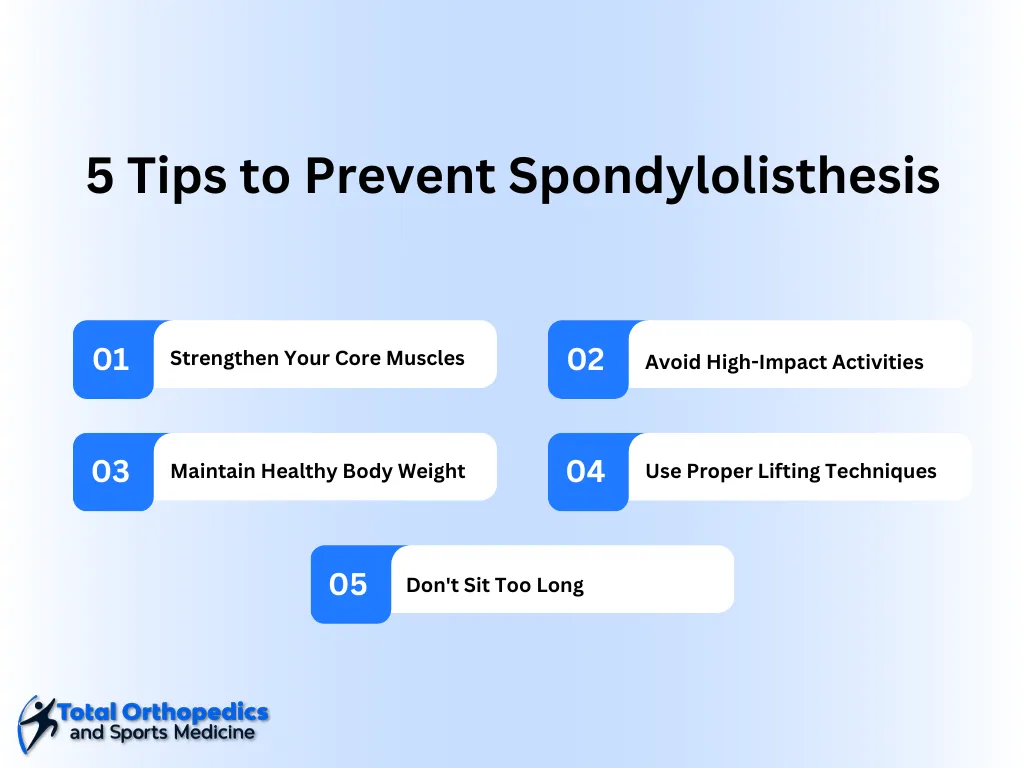
To prevent spondylolisthesis, focus on maintaining a healthy spine through proper posture and avoiding activities that strain your lumbar spine. Additionally, practicing good body posture when lifting and avoiding sudden movements can reduce the risk of stress fractures or lumbar instability.
Gentle movements help stabilize the lumbar vertebrae and reduce the risk of spinal instability. Moreover, staying active, maintaining a healthy weight, practicing the proper position of your back, and avoiding smoking also contribute to spinal health. Monitoring your body and addressing associated symptoms like tight hamstrings or lower back pain early can prevent further degenerative spinal changes.
Let Total Orthopedics & Sports Medicine Help You Manage Spondylolisthesis Pain — Schedule Your Appointment Today!
Dealing with spondylolisthesis can be difficult, especially when back and abdominal muscle tightness and radiating pain interfere with your everyday life. Over time, these symptoms can worsen, resulting in spinal instability and further complications like nerve compression. If left untreated, you may risk degenerative spinal changes that affect your overall mobility.
At Total Orthopedics & Sports Medicine, we specialize in diagnosing and treating spondylolisthesis and offer customized care plans for spondylolisthesis patients to relieve pain, improve mobility, and maintain spinal stability. Our experts are committed to helping you manage your spine health and live a pain-free life. Contact us at 855-321-6784 to schedule your appointment today.
FAQs
Can Spondylolisthesis Cause Bowel Issues?
Yes, in severe cases, high-grade spondylolisthesis can cause bowel issues. When the vertebral slip in the lower lumbar spine compresses the spinal canal, it may affect the nerve roots, including those responsible for bowel control. This could lead to cauda equina syndrome, a condition that causes severe pain, loss of bladder control, and other symptoms. Early treatment can help prevent these complications.
Can Spondylolisthesis Be Asymptomatic?
Yes, spondylolisthesis can be asymptomatic in some cases, particularly in low-grade spondylolisthesis. Many individuals may have a vertebral slip without noticeable pain. However, as degenerative spinal changes progress, symptoms like lumbar pain, tight hamstring muscles, and nerve compression may develop. Therefore, magnetic resonance imaging (MRI) or computed tomography (CT) scans can detect the condition even when symptoms are mild or absent.
What Are the Risk Factors for Spondylolisthesis?
Risk factors for spondylolisthesis include sudden injury, age-related degenerative changes, and congenital disabilities. Athletes, especially those engaged in activities requiring repetitive motion, may be at higher risk. Other factors like pelvic tilt, poor posture, and lumbar instability can increase susceptibility. Additionally, spinal arthritis or conditions affecting the cervical spine or thoracic spine may increase the risk of developing spondylolisthesis.
How Does Spondylolisthesis Affect Posture?
Spondylolisthesis can affect your posture by causing vertebral slippage in the lumbar spine, resulting in lumbar pain and spinal instability. As your body adjusts to tight hamstrings and abdominal muscles, it may shift the alignment of your pelvis, affecting your pelvic incidence and leading to an abnormal pelvic tilt. Over time, this can cause poor posture, further aggravating spondylolisthesis symptoms and potentially requiring spondylolisthesis treatments such as surgical treatment or spinal fusion.
Can Spondylolisthesis Lead to Spinal Arthritis?
Yes, spondylolisthesis can lead to spinal arthritis. The vertebral slip can disrupt normal spinal alignment, causing wear and tear on the facet joints and discs, leading to degenerative conditions like spinal arthritis. Over time, spondylolisthesis can cause severe pain, stiffness, and limited mobility, especially in the lower lumbar spine. Therefore, early intervention with epidural steroid injections or spondylolisthesis surgery can help prevent further damage.


