

Can Disc Replacement Reverse Muscle Atrophy from Nerve Compression?
Yes, disc replacement surgery can reverse muscle atrophy (muscle shrinkage). However, the final outcome depends on the duration and severity of the compression and the nerve’s ability to recover. If prolonged pressure has caused permanent nerve damage (when nerve cells can no longer regenerate), the muscle loss may not improve.
At Total Orthopedics and Sports Medicine, our spine specialists perform disc replacement using advanced motion-preserving techniques to support nerve healing. We also schedule regular follow-ups to track your recovery and adjust your treatment plan accordingly. Beyond that, our team guides you with insurance coverage, referrals, and co-pay coordination to ensure a smooth recovery process. Call 855-321-6784 to get an effective treatment plan.

How Does LDR Improve Muscle Loss Caused by Nerve Compression?
Disc replacement surgery relieves pressure on the compressed spinal nerve and restores normal nerve function. During the procedure, your surgeon removes the herniated or affected disc that presses on the nerve root, which provides immediate pain relief. Once the pressure is removed, signaling between the nerve and the affected muscle improves. This recovery process, known as reinnervation, stimulates weakened muscle fibers and promotes structural recovery.
Artificial disc replacement (ADR) also preserves natural spine movement by replacing the damaged disc with a mobile implant. Because the artificial disc mimics the natural movement, your surrounding muscles do not need to overcompensate for stiffness. This balanced movement supports long-term muscle recovery and helps prevent further weakness.
What Are the Early Signs of Muscle Atrophy from Nerve Compression?
Ongoing numbness, tingling (pins-and-needles sensation), and localized weakness often signal early changes in muscle function due to nerve pressure. As these symptoms persist, you may also notice visible muscle wasting (one limb appearing smaller), along with muscle cramps and increasing difficulty performing daily tasks like lifting or gripping. Beyond that, muscle twitching, stiffness, neck, or arm pain indicates that the affected nerve is not properly supporting the muscle.
Here is how these signs lead to progressive decline in muscle strength and function:
Persistent Numbness/Tingling
This sensation, known as paresthesia (an abnormal feeling like pins and needles), is an early warning sign of nerve irritation. It indicates that the nerve is under continuous pressure. As a result, this ongoing strain disrupts normal nerve signal transmission and leads to reduced sensation and control. Over time, if the nerve cannot send proper signals, you may notice muscle weakness and gradual shrinking (muscle wasting).
Muscle Weakness
According to NIH research, muscle strength depends on the balance between muscle protein synthesis (muscle building) and muscle protein breakdown (muscle loss). Nerve compression can disrupt this balance by limiting proper nerve signals to the muscle. This imbalance reduces the muscle’s ability to maintain its size and function, which can affect your balance and overall control. As a result, you may struggle to lift objects or experience difficulties with fine motor tasks. Without timely treatment, this ongoing weakness can lead to permanent muscle loss.
Muscle Twitching (Fasciculations)
You may notice brief, involuntary back muscle movements that appear as small flickers or fluttering under the skin. These movements, known as fasciculations (spontaneous muscle fiber contractions), often occur in areas such as the calves, thighs, eyelids, hands, or feet. In some cases, these twitches may occur occasionally or continue for longer periods.
Pain or Stiffness
You may notice a constant aching or sharp pain that often worsens at night or with certain movements. This pain can spread from the back into the buttocks or legs, known as sciatica (radiating nerve pain). It may also increase when you sit, bend, or change positions. At the same time, you may feel muscle stiffness because the affected nerve fails to send proper signals. This disruption leads to tight, less flexible back muscles and reduced movement control.
Visible Muscle Wasting
If the compression is not treated within 4–6 weeks, the muscle loss often becomes clearly visible. In such a case, you may notice that one limb, such as an arm or leg, appears visibly smaller or thinner than the other. Over time, these changes may lead to permanent nerve damage and irreversible muscle loss, along with reduced strength and limited movement in the affected area.
Which Muscles Are Commonly Affected by Lumbar Disc Compression?
Lumbar disc compression (often caused by a herniated or bulging disc) most commonly affects muscles in the legs and feet due to nerve impingement. However, the affected muscles depend on which nerve root is compressed in the lower spine. For instance, if the L5 nerve root gets compressed, you may notice weakness in the anterior tibialis, hallucis longus, peroneals, and hip abductors. Similarly, if the S1 nerve root is compressed, it can affect the gastrocnemius, soleus, hamstrings, and the gluteus muscles.
What’s the Difference Between Disuse VS. Nerve-Related Atrophy?
Disuse atrophy develops when a muscle loses strength due to prolonged inactivity, such as extended bed rest, immobilization in a cast, or a sedentary lifestyle. In contrast, nerve-related atrophy (neurogenic atrophy) occurs when damaged spinal nerves fail to transmit signals to the muscle, leading to progressive muscle wasting.
Nerve compression may also cause numbness or tingling that travels along the limb, whereas disuse atrophy does not disrupt nerve signaling. In addition, a nerve-related atrophy often requires targeted medical intervention to relieve chronic back pain, while disuse atrophy typically improves with structured exercise and rehabilitation.
Is Disc Replacement Better Than Fusion for Restoring Muscle Strength?
Yes, disc replacement often supports functional muscle recovery more than fusion surgery. It maintains natural spinal movement and helps rebuild strength more effectively. In contrast, fusion limits natural motion, which can increase stiffness and place added stress on nearby muscles, and increase the risk of adjacent segment disease (disc degeneration).
In addition, NIH research reports better long-term functional outcomes with disc replacement compared to traditional spinal fusion surgery. Researchers reviewed 5-year data from 4 studies comparing patients who had an artificial disc surgery with those who underwent fusion. Their findings showed the following key results:
- Improved functional outcomes: 9% higher success in disability improvement
- Greater patient satisfaction: 13% higher satisfaction rates
- Lower reoperation rates: 48% reduced risk of additional surgery
How Do Doctors Assess Muscle Weakness Before Disc Replacement Surgery?
To assess muscle weakness before disc replacement surgery, our experienced spine surgeon, Dr. Georgiy Brusovanik, MD, reviews your medical history and performs clinical neurological exams. If necessary, he may order an MRI, NCV, or EMG to assess degenerative disc disease or other spinal abnormalities. During examination, Dr. Georgiy Brusovanik may also conduct the following physical examinations to confirm the diagnosis:
- Manual Muscle Testing (Oxford Scale): Tests specific muscle groups against resistance and grades strength from 0 (no contraction) to 5 (normal strength).
- Deep Tendon Reflex Testing: Checks reflex responses to assess the integrity of the nerve pathway.
- Sensory Mapping: Identifies areas of numbness, tingling, or altered sensation along specific nerve distributions.
- Functional Movement Assessment: Observes posture, gait, and coordination to detect muscle imbalances.
Moreover, our disc arthroplasty surgeon, Dr. Georgiy Brusovanik, reviews your daily activities and overall spinal health to determine whether artificial disc replacement surgery is suitable for your spinal condition. If surgery is not the most appropriate choice, he will guide you toward minimally invasive or conservative treatment options, depending on the severity of your symptoms and imaging findings. Call us today at 855-321-6784 to book your consultation with Dr. Georgiy Brusovanik.
Does Duration of Symptoms Predict Muscle Recovery After Surgery?
Yes, symptom duration affects muscle recovery after spine surgery. For instance, prolonged nerve compression increases the risk of permanent muscle weakness and may reduce the chances of full muscle recovery. In contrast, most patients who receive treatment within 6 months to 1 year often experience greater functional improvement.
In fact, research in the Spine Journal found that patients who had surgery within 3 months reported a 74% satisfaction rate, while those who waited more than 24 months reported a 48.7% satisfaction rate. Early treatment also led to better functional outcomes, with 77.4% of patients reporting significant improvement in spinal motion and their daily activities.
Can Neuromuscular Electrical Stimulation Reverse Atrophy After Surgery?
Yes, Neuromuscular Electrical Stimulation (NMES) can help reverse muscle atrophy after total disc replacement. It sends controlled electrical impulses to your muscles, producing contractions that keep the tissue active during the immobilization phase (limited movement). This early stimulation helps preserve muscle mass and supports strength as your body recovers.
Neuromuscular Electrical Stimulation (NMES) also helps reduce post-operative pain and improve communication between your nerves and muscles. Moreover, the Journal of Applied Physiology reports that a single session of high-frequency, high-intensity NMES increased muscle protein synthesis by 27%, which supports muscle repair and functional recovery.
Is PRP Effective for Nerve Recovery After Disc Replacement?
Yes, Platelet-Rich Plasma (PRP) is a safe option that can support nerve recovery and reduce pain after disc replacement. Doctors use PRP by concentrating your own platelets (cells that help in healing) and delivering them to the affected area to stimulate tissue repair. Once applied, these platelets release growth factors (healing proteins) that reduce inflammation and support nerve regeneration. Over time, this process can improve nerve signaling, ease pain, and restore better muscle function.
In fact, a study published in the Journal of Regenerative Therapy shows that PRP with a higher platelet concentration can significantly support nerve healing and repair. The research reveals that PRP stimulates Schwann cells (cells that help repair and protect nerves) and restores damaged nerve function. PRP also improves blood flow and supports tissue structure by stimulating collagen production.
Similarly, an NIH study reports that PRP improves both sensory and motor (movement) recovery after nerve injury. It reduces scar formation and releases neurotrophic factors such as TGF-β and IGF-1 that help control inflammation. Beyond these benefits, research found that surgeons achieve better results when they combine PRP with surgical techniques and supportive materials. However, the following factors affect PRP therapy outcomes in nerve repair:
- Preparation Technique: Determines PRP quality and strength.
- Centrifugation Process: Controls platelet and growth factor levels.
- Age: Younger individuals show a better healing rate.
- Health Condition: Overall health impacts treatment outcome.
How Do Isometrics Rebuild Muscle While the Nerve Heals After LDR?
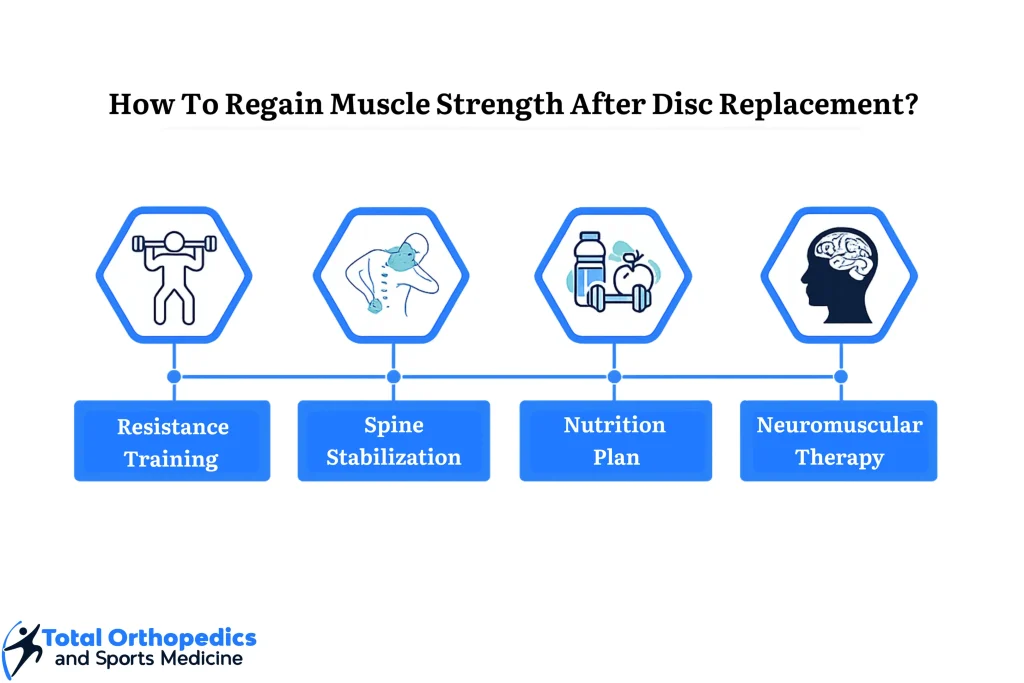
Isometric exercises rebuild muscle after disc replacement by activating weakened muscles without placing excess strain on the spine. These controlled contractions create internal muscle tension that strengthens stabilizing muscles while keeping the joints steady and aligned. As the nerve gradually recovers, this muscle activation improves neuromuscular coordination and the spine’s natural range of motion.
According to NIH research, the following isometric exercises improve core strength and spinal stability:
- Curl-Up: Lie on your back with one knee bent and one leg straight. Then, support your lower back with your hands, lift your head and shoulders slightly.
- Side Bridge: Lie on your side with knees bent, support your upper body on your elbow, and lift your hips off the floor.
- Bird Dog: Start on hands and knees, raise one arm or one leg at a time while keeping your spine stable.
Can Nutritional Deficiency Slow Muscle Recovery After Disc Replacement?
Yes, nutritional deficiency can significantly slow muscle recovery and weaken overall rehabilitation after disc replacement. In fact, an NIH study reports that adequate nutrition is essential for managing surgical stress and supporting muscle recovery. It also reduces the risk of infection and the duration of hospital stay. Without proper nutrition, your body cannot effectively rebuild damaged muscle. Over time, this can lead to muscle atrophy (muscle loss), reduced independence, and higher health risks, especially in older adults.
Here are key nutrients that affect recovery and tissue healing after lumbar disc replacement surgery:
Carbohydrate and Protein Deficiency
Protein provides essential amino acids (building blocks of muscle) that your body needs to repair damaged tissue and rebuild muscle. At the same time, carbohydrates provide energy to support this repair process and prevent muscle breakdown. Moreover, the National Athletic Trainers’ Association suggests that diets with around 40% carbohydrates or a 2:1 carbohydrate-to-protein ratio (for example, 260 g carbs and 130 g protein) support better recovery. However, low intake of protein and carbohydrates leads to muscle atrophy (loss of muscle mass) and delays overall healing after disc replacement surgery.
Vitamin C
Low levels of vitamin C can delay healing and slow muscle recovery after disc replacement surgery. However, maintaining proper vitamin C levels supports collagen production (a protein that repairs tendons and ligaments) and helps rebuild tissues around the spine. In addition, it reduces oxidative stress (cell damage caused by harmful molecules) and inflammation, which helps ease postoperative pain. As a result, it speeds up wound healing and reduces the need for pain medication during recovery.
Magnesium and Potassium
Magnesium helps reduce muscle spasms, supports nerve function, and acts as a natural muscle relaxant, which can ease pain after disc surgery. Potassium supports proper cellular function and helps prevent muscle weakness that often increases during recovery. With proper levels of both minerals, your muscles can contract and relax smoothly, which supports healing and reduces discomfort.
Vitamin D Deficiency
Vitamin D supports muscle strength and calcium absorption (a mineral needed for bone health) after disc replacement surgery. In fact, an NIH study reports that patients with adequate vitamin D levels show faster improvement in strength, balance, and mobility after surgery. In contrast, deficiency can lead to muscle weakness, delayed recovery, and poor healing around the implant, especially in older adults.
How Long Does It Take To Regain Muscle Strength After Disc Replacement?
You can regain noticeable muscle strength within 3 to 6 months after disc replacement surgery. During this period, many patients also experience improved range of motion as the artificial disc replacement procedure restores movement. However, in severe cases, recovery may extend up to a year, especially if multiple levels of the spine are treated. Since recovery time varies for each surgical procedure, you should follow your surgeon’s instructions to support proper healing and overall quality of life.
Quick Tip: To prevent surgical site infection, you should keep the incision dry, avoid smoking, and perform gentle movements for the first few weeks of recovery.
Let Total Orthopedics & Sports Medicine Help You Manage Muscle Atrophy After Disc Replacement!
After a disc replacement, muscle atrophy can reduce your strength and mobility, limit your independence, and cause chronic pain and fatigue. During recovery, you may also experience emotional disturbance, social isolation, and a higher risk of falls, fractures, and implant issues (failed disc replacement).
At Total Orthopedics & Sports Medicine, our orthopedic surgeon, Dr. Georgiy Brusovanik, MD, examines the underlying cause of the condition and designs an evidence-based spine treatment plan using minimally invasive techniques. Moreover, he also offers a second opinion if the disc replacement fails to relieve pain and restore function. Call 855-321-6784 or visit 1111 Park Ave, #1, NY 10128 to protect your long-term nerve health.
FAQs
Can Scar Tissue Affect Nerve Recovery After Disc Replacement?
Yes, scar tissue can affect nerve healing after disc replacement surgery. During recovery, your body forms healing tissue around the spinal canal, which may place pressure on nearby nerves. As this pressure increases, you might experience burning pain similar to a degenerated disc or spinal stenosis.
Does Age Affect Muscle Recovery After Surgery?
Yes, age affects muscle recovery after surgery because it reduces the body’s ability to repair and rebuild muscle tissue efficiently. Aging also slows satellite cell activity and may prolong inflammation. As a result, older adults often require extended rehabilitation to restore strength and prevent spinal instability.
What Movements Should I Avoid While The Nerve Heals?
Avoid high-impact activities and twisting motions like running, burpees, golf swings, or one-handed lifting during healing. Prolonged sitting and bending can also increase pressure on the irritated nerve. Instead, focus on slow, controlled movements that protect the spinal disc and promote steady recovery.
Can Implant Issues Cause The Return Of Weakness Or Atrophy?
Yes, implant problems can cause weakness or muscle atrophy to return after surgery. If an artificial disc shifts, loosens, or wears out, it may compress a nerve and trigger arm weakness. Adjacent segment degeneration can also increase spinal cord pressure and persistent pain.
How Do I Know If My Muscle Loss Is From Nerve Damage Or Disuse?
Muscle loss from nerve damage develops rapidly and often causes weakness or burning nerve pain. In contrast, disuse-related muscle loss progresses slowly, leading to mild weakness or stiffness. While nerve damage affects specific muscles supplied by one nerve root, disuse causes generalized atrophy.


