

Which Is Better: ACL Repair vs. Reconstruction?
ACL reconstruction is often the better option for complete, chronic, or frayed tears, especially for athletes who perform sudden directional changes. In contrast, ACL repair is recommended for recent tears near the thigh bone when healthy ligament tissue can support repair. However, the right choice depends on the tear pattern, tissue quality, and your activity level.
At Total Orthopedics & Sports Medicine, our knee specialists assess your ligament damage and develop a personalized treatment plan tailored to your needs. We also discuss the benefits of each surgical option and guide you toward the most suitable procedure. After surgery, you can access our detailed post-surgical instructions to understand wound care and recovery precautions. Call 855-321-6784 to schedule a consultation and choose the right ACL treatment for your knee.

Key Takeaways
- ACL repair preserves your original ligament, while reconstruction replaces the torn ligament with a tendon graft.
- Repair works best for recent tears near the thighbone when the original ligament tissue is healthy.
- ACL reconstruction is often better for complete, chronic, or complex tears, especially in active athletes.
- A meta-analysis of 908 patients reported failure rates of 12% after ACL repair and 5.3% after reconstruction.
- ACL repair may offer faster early recovery, but returning to competitive sports often takes 9–12 months with either procedure.
- Your surgeon will assess tear location, tissue quality, age, and activity level to recommend the right ACL procedure.
What Is the Difference Between ACL Repair and Reconstruction?
ACL repair uses stitches and anchors to reattach the torn ligament to the bone while preserving your native ACL. In contrast, ACL reconstruction replaces the damaged ligament with a tendon graft from your own body or donor tissue. While both procedures aim to restore knee joint stability, the following table compares their surgical techniques, recovery, and suitability:
| Factors | ACL Repair | ACL Reconstruction |
|---|---|---|
| Procedure | Reattaches the original ligament to the bone | Replaces the damaged ligament with a new graft |
| Best For | Recent tears near the thigh bone with healthy tissue | Complete, chronic, or frayed tears |
| Tissue Source | Preserves your original ACL | Uses your own tendon or donor tissue |
| Surgical Technique | Uses sutures and anchors | Uses bone tunnels to secure the graft |
| Recovery Time | Often 6–9 months for sports | Usually 9–12 months for sports |
| Re-tear Risk | Higher in younger, active patients | Generally lower with an appropriate graft |
| Surgical Incisions | Usually smaller incisions | Small incisions plus possible graft harvest sites |
Who Is a Good Candidate for ACL Repair?
You may qualify for ACL repair if you have a partial tear with intact ligament attachments or a recent tear near the thigh bone with healthy tissue. In such cases, surgeons can reattach the damaged ligament while preserving your native ACL. According to an NIH-indexed systematic review, researchers evaluated 614 patients across 18 studies to assess the outcomes of primary ACL repair. The results showed a 12.6% failure rate after at least two years of follow-up.
Patients also achieved average IKDC and Lysholm knee function scores of 91.7 and 94.7 out of 100, respectively. However, your eligibility also depends on tissue quality, tear location, and your ability to follow a structured recovery plan. Surgeons also evaluate the following factors before they recommend ACL repair surgery:
- Strong Healing Potential: Younger patients or individuals with healthy ligament tissue that supports natural repair.
- Mild Knee Instability: Patients with limited joint instability and a favorable tear pattern.
- Commitment to Rehabilitation: Patients who can follow prescribed exercises, activity restrictions, and postoperative recovery protocols.
When Is ACL Reconstruction Better Than Repair?
Surgeons recommend ACL reconstruction over repair when the torn ligament has poor tissue quality or cannot support direct reattachment. For example, mid-substance tears affect the ligament’s center, which has a limited blood supply. As a result, these tears have a lower chance of natural healing.
Similarly, chronic tears can cause the native ACL to retract or weaken over time. In such cases, reconstruction uses a tendon graft to restore knee joint stability and generally carries a lower risk of retear than primary repair. Moreover, surgeons may recommend reconstruction for complex injuries with damage to other knee structures, such as:
- Meniscus Tears
- Medial Collateral Ligament (MCL) Tears
- Posterior Cruciate Ligament (PCL) Tears
- Lateral Collateral Ligament (LCL) Tears
- Posterolateral Corner (PLC) Injuries
Which ACL Surgery Is Better for Athletes?
ACL reconstruction with an autograft (tissue from your own body) is often recommended for competitive athletes who need reliable knee joint stability. This procedure supports a return to pivot and contact sports, such as soccer and basketball. In contrast, ACL repair may be appropriate for selected athletes with recent proximal tears, but it carries a higher risk of retear in younger, active patients. For this reason, surgeons evaluate the following factors before recommending the most suitable procedure:
- Age: Younger athletes face a higher risk of an anterior cruciate ligament (ACL) tear.
- Sport Type: Pivot and contact sports place greater stress on the ACL.
- Playing Position: Positions with frequent cuts and sudden turns demand greater knee stability.
- Activity Level: Competitive athletes often need a durable graft for high-intensity sports.
Which Is the Best Graft for ACL Reconstruction?
Surgeons commonly choose between autografts (tissue from your own body) and an allograft (donor tissue) to replace the torn ligament. During surgery, they often secure the new graft with titanium interference screws to support knee stability. Proper graft placement at the ACL’s natural attachment sites between the thigh and shin bones also supports successful reconstruction.
Each option offers distinct benefits and risks regarding graft strength, recovery, and long-term knee stability. However, the best graft choice depends on your age, activity level, and knee condition. The following graft types can help you understand their benefits and limitations:
1. Bone-Patellar Tendon-Bone (BPTB) Autograft
A patellar tendon autograft uses the middle third of your patellar tendon with small bone plugs from the kneecap and shin bone. These bone plugs provide strong initial fixation and support direct bone-to-bone healing compared to hamstring grafts. For this reason, surgeons often recommend this graft for competitive athletes who need reliable knee stability. However, it carries a higher risk of front knee pain, kneeling discomfort, and, rarely, kneecap fracture.
2. Hamstring Tendon Autograft
Surgeons create hamstring grafts from one or two tendons at the back of your thigh to replace the damaged ACL. This option requires a smaller tissue-harvest incision and generally causes less front knee pain than a patellar tendon graft. However, tendon-to-bone healing takes time, and some patients experience reduced hamstring strength after surgery. Smaller graft diameters may also increase the risk of graft failure, especially in younger athletes.
3. Quadriceps Tendon Autograft
Quadriceps tendon autografts are an increasingly popular option for ACL reconstruction due to their strength and tissue quality. Surgeons use a thick strip of tendon from just above your kneecap to replace the damaged ACL. Its large size and high tensile strength offer reliable support for knee joint stability. It may also cause less front knee pain than a patellar tendon graft. However, some patients experience temporary quadriceps weakness during early rehabilitation.
4. Allograft (Donor Tissue)
Unlike autografts, an allograft uses tendon tissue from a deceased donor instead of your own body. This eliminates donor-site pain and can reduce operative time. However, donor tissue may take longer to incorporate into the knee than an autograft.
It also carries a higher risk of re-tear in young, active athletes, particularly those under age 25. In fact, a study found that ACL reconstruction with allografts was associated with 2.84 times higher odds of graft rupture than autografts.
How Long Does ACL Repair vs. Reconstruction Surgery Take?
ACL repair typically takes 1 to 2 hours, as surgeons reattach the torn ligament using stitches or anchors without harvesting a graft. In contrast, ACL reconstruction takes approximately 50 minutes to 3 hours, depending on graft selection and surgical complexity. Both procedures are usually performed on an outpatient basis.
Patients generally spend around 4 hours at the surgical center for ACL repair and 4 to 5 hours for reconstruction. After surgery, rehabilitation exercises support a gradual return to daily activities and light exercise within 3 to 6 months. However, returning to competitive sports often takes 9 to 12 months, depending on knee strength, stability, and recovery progress.
Is ACL Repair Recovery Faster Than Reconstruction?
Yes, ACL repair can offer a faster early recovery than ACL reconstruction because surgeons preserve the original ligament rather than harvest a tendon graft. As a result, patients may experience less postoperative pain and regain knee movement sooner. However, both procedures require structured rehabilitation, and the timeline for a return to competitive sports may be similar.
In fact, a study published in Advances in Orthopedics compared recovery after both procedures. Researchers evaluated 21 patients who had undergone ACL repair in one knee and reconstruction in the other. After at least two years of follow-up, researchers reported the following outcomes:
- Less Pain: 78% reported less pain during rehabilitation after ACL repair.
- Earlier Knee Movement: 83% regained their range of motion sooner after repair.
- Faster Rehabilitation: 83% reported improved function and faster recovery after repair.
- Similar Knee Function: Both procedures produced comparable patient-reported functional scores.
Rehabilitation exercises usually begin soon after ACL surgery to restore knee movement and muscle strength. As recovery progresses, patients may return to running around four months after surgery if their knee meets the required recovery milestones. However, athletes should generally wait at least nine months before returning to competitive sports. This timeline applies to both procedures, as a faster early recovery after ACL repair does not guarantee an earlier return to sports.
How Many Years Does an ACL Repair Last?
A successful anterior cruciate ligament reconstruction may last 15 to 20 years or longer. Its durability depends on your age, activity level, and the condition of the repaired ligament. New knee injuries and high-demand sports can also increase the risk of another tear over time.
In fact, a study published in The American Journal of Sports Medicine evaluated long-term outcomes after primary ACL repair. Researchers followed 107 patients with tears near the thigh bone for a median of six years. The overall failure rate increased from 11.5% at two years to 15.9% at five years. However, 88% of patients achieved an acceptable knee function score on the IKDC assessment, which supports lasting benefits for selected patients.
Another study published in the Scandinavian Journal of Medicine & Science in Sports examined 100 patients over 15 years after ACL injury. Researchers compared primary ACL repair with nonsurgical treatment. Both groups reported similar activity levels and knee function outcomes, although the nonsurgical group experienced more instability symptoms. About one-third of patients in the nonsurgical group eventually required ACL reconstruction due to instability.
Which Has a Higher Retear Risk: ACL Repair or Reconstruction?
ACL repair generally carries a higher retear risk than ACL reconstruction, particularly in younger, active patients. This difference occurs because repair preserves the damaged ligament, while reconstruction replaces it with a tendon graft. However, the risk of another tear also depends on your age, activity level, and ligament condition.
A meta-analysis published in BMC Surgery compared ACL repair vs. reconstruction across 14 studies with 908 patients. The results showed a higher failure rate after repair, with 47 of 391 cases compared to 20 of 377 after reconstruction. This represented failure rates of 12.0% for ACL repair and 5.3% for ACL reconstruction.
However, both procedures showed similar patient-reported knee function and activity scores on two key measures. Researchers also found that repair can offer comparable outcomes for selected patients with recent tears near the thigh bone.
What Are the Surgical Risks of ACL Repair and Reconstruction?
Both ACL repair and anterior cruciate ligament reconstruction carry risks of postoperative pain, swelling, and knee stiffness. Patients may also experience temporary muscle weakness or wound infections after surgery. However, proper wound care and structured rehabilitation protocols can reduce certain complications and support knee recovery.
In addition, you may experience the following complications after ACL surgery:
- Blood Clots: Rare clots in the legs can reach the lungs and require emergency care.
- Nerve Damage: Small nerve injuries can cause temporary or permanent numbness around the knee.
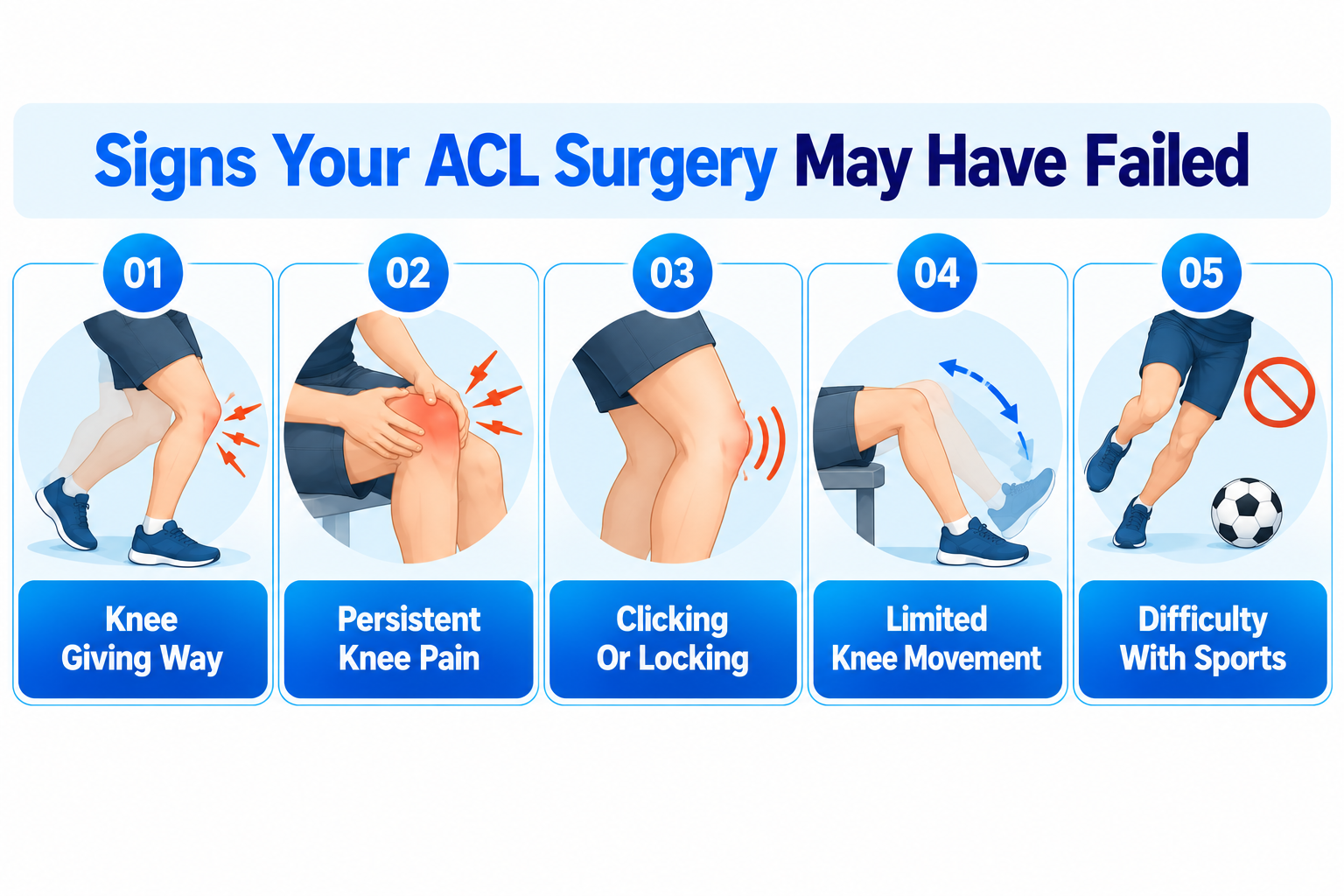
- Graft Failure: The repaired ligament or new graft can tear again, particularly during high-impact sports.
- Incorrect Tunnel Placement: Poor placement of bone tunnels in the femur or tibia can cause persistent knee instability.
- Hardware Problems: Screws or other fixation devices may cause irritation or discomfort.
- Missed Knee Injuries: Untreated meniscus or cartilage damage can affect long-term knee stability.
- Post-Traumatic Arthritis: Cartilage damage from the original injury can contribute to knee arthritis years after surgery.
Can an ACL Tear Heal Without Surgery?
Yes, a torn ACL can sometimes heal without surgery, particularly if the tear is partial and the knee remains stable. However, complete tears have limited natural healing potential, although some can heal under favorable conditions. For mild or stable injuries, a doctor can guide rehabilitation exercises to restore muscle strength and knee stability. They may also recommend a knee brace and activity modification to support recovery and a gradual return to normal activities.
ACL Repair vs Knee Replacement: What Is the Difference?
ACL repair fixes a torn ACL to restore knee stability, particularly in younger or active patients. In contrast, total knee replacement removes damaged joint surfaces and replaces them with artificial metal and plastic components to treat advanced arthritis. Therefore, surgeons recommend ACL repair for ligament injuries and knee replacement for extensive joint damage.
Here are the key differences between ACL repair and total knee replacement:
| Comparison | ACL Repair | Total Knee Replacement |
|---|---|---|
| Purpose | Restores stability after an ACL tear | Relieves arthritis pain and improves mobility |
| Best For | Patients with suitable, repairable ligament tears | Patients with advanced knee joint arthritis |
| Tissue Preserved | Preserves the patient’s original ACL tissue | Removes damaged cartilage and underlying bone |
| Recovery Time | Often 6–9 months for sports recovery | Often 3–6 months for substantial recovery |
| Long-Term Goal | Restores natural ligament function and stability | Reduces joint pain and improves movement |
How Much Does ACL Repair vs Reconstruction Cost?
In New York, ACL reconstruction typically costs between $20,000 and $50,000 without insurance. In contrast, ACL repair generally costs between $15,000 and $35,000. However, the total cost of either procedure depends on multiple factors, such as your insurance coverage, surgical technique, and hospital fees. Other factors that can affect your final treatment cost are:
- Surgeon’s Fees: Experience and procedure complexity.
- Hospital Charges: Facility and operating room expenses.
- Anesthesia Costs: Type and duration of anesthesia.
- Graft Choice: Autograft or donor tissue costs.
- Surgical Equipment: Anchors, screws, or an internal brace.
- Rehabilitation Costs: Postoperative exercises and therapy sessions.
- Additional Injuries: Treatment for associated meniscus or cartilage damage.
Consult Our Knee Specialists to Choose Between ACL Repair and Reconstruction!
After an ACL injury, you may feel uncertain about which surgical option will restore your knee stability. You may also worry about recovery time, potential complications, and when you can return to your normal routine. With different procedures and treatment costs to consider, choosing the right treatment can be difficult.
At Total Orthopedics & Sports Medicine, our knee specialists review your MRI scans, assess your injury mechanism, and examine your knee stability. We consider multiple factors, including ligament damage, activity demands, recovery expectations, surgical risks, and treatment costs, to recommend the most suitable procedure. Our team also explains your treatment plan and offers convenient online bill payment through our patient portal. Call 855-321-6784 or visit our New York clinics to schedule a consultation and find the right ACL surgery for your needs.
FAQs
Can I Get ACL Surgery If My Growth Plates Are Still Open?
Yes, you can undergo ACL surgery even if your growth plates are still open. However, standard adult surgical techniques may damage these plates and affect normal bone growth. To reduce this risk, surgeons may use growth plate-sparing techniques, such as iliotibial band reconstruction.
Will I Lose Muscle Strength After an ACL Graft?
Yes, you may experience temporary muscle weakness after ACL surgery due to reduced activity. A hamstring autograft can also cause donor site morbidity (pain or weakness at the tissue harvest site). However, rehabilitation exercises can restore strength, whereas an Achilles tendon allograft avoids muscle weakness associated with tendon harvesting.
Can I Return to Soccer After ACL Repair?
Yes, you can return to soccer after ACL repair if your knee regains adequate strength and stability. However, most specialists recommend waiting at least 9 to 12 months before returning to competitive soccer. During this period, structured rehabilitation exercises can restore knee function and prepare you for sudden turns, cuts, and pivots.
Can I Have ACL Reconstruction Twice on the Same Knee?
Yes, you can undergo ACL reconstruction twice on the same knee. Surgeons recommend this procedure if the original graft fails, tears again, or a new injury damages the ligament. However, revision surgery is more complex because surgeons must assess existing bone tunnels, remove scar tissue, and select a suitable new graft.
Can My Torn ACL Be Repaired With an Internal Brace?
Yes, a torn ACL can be repaired with an internal brace if the injury is recent and the ligament tissue is healthy. This ligament augmentation device supports the repaired ACL as it heals. However, this procedure is typically reserved for suitable tears treated within six weeks, while older tears often require reconstruction.

